How to Write Foreign Names in Japanese Katakana
Converting a Name into Japanese Katakana
When creating a Japanese-style name stamp, I first consider how the name is pronounced. I then choose katakana that represents the closest natural Japanese pronunciation.
TL;DR
Foreign names are usually written in katakana according to their pronunciation, not translated letter by letter. Because Japanese has a different sound system, some names may have more than one possible spelling.
Why names change in Japanese
Japanese has a different sound system from English and many other languages. Some sounds and sound combinations used in foreign languages do not exist naturally in Japanese.
Because of this, a foreign name is usually written according to its pronunciation rather than converted one letter at a time. The result is an approximation of the original pronunciation using Japanese sounds.
For example:
Name | Katakana | Approximate pronunciation |
|---|---|---|
Michael | マイケル | Maikeru |
Sarah | サラ | Sara |
John | ジョン | Jon |
The most suitable katakana spelling may depend on:
* The person’s preferred pronunciation
* The original language of the name
* The spelling commonly used in Japan
* Whether the name contains sounds that Japanese does not have
Because Japanese and other languages use different sound systems, some names may have more than one reasonable katakana spelling. I aim for a version that sounds natural and remains recognizable.
Well-known names
Some well-known names already have an established Japanese spelling. When one exists, it is usually best to use that spelling rather than create a new one.
For example:
Michael → マイケル
John → ジョン
London → ロンドン
A note about EEFOTO name stamps

EEFOTO name stamps are decorative digital artwork inspired by Japanese name seals. They are not official Japanese seals, legal seals, inkan, or hanko. They cannot be used for legal, banking, governmental, contractual, or registered purposes.
Kana: The Japanese Sound System
Japanese uses two basic kana writing systems: hiragana and katakana. They usually represent the same sounds but have different forms and typical uses.
Hiragana
Hiragana is mainly used for:
* Native Japanese words
* Grammatical elements
* Verb and adjective endings
* Words for which kanji is not used
Katakana
Katakana is commonly used for:
* Foreign loanwords
* Foreign names and place names
* Onomatopoeia
* Emphasis
* Some scientific and technical terms
Hiragana and katakana generally represent the same sounds. For example:
* か = カ = ka
* き = キ = ki
* す = ス = su
The difference is their appearance and typical use.
How many basic kana are there?
Hiragana and katakana each have 46 basic kana symbols in the traditional basic chart. These 46 symbols include kana such as か (ka), し (shi), and と (to). They do not represent only individual consonants or vowels.
Additional sounds are created by using:
* Voicing marks: カ → ガ
* Small ゃ, ゅ, and ょ: キ → キャ
* Small ッ: ナツ → ナッツ
* Combinations for foreign sounds: ファ, ティ, ウェ
* The long-vowel mark ー in katakana
These additional forms are often needed when writing foreign names.
Listening practice
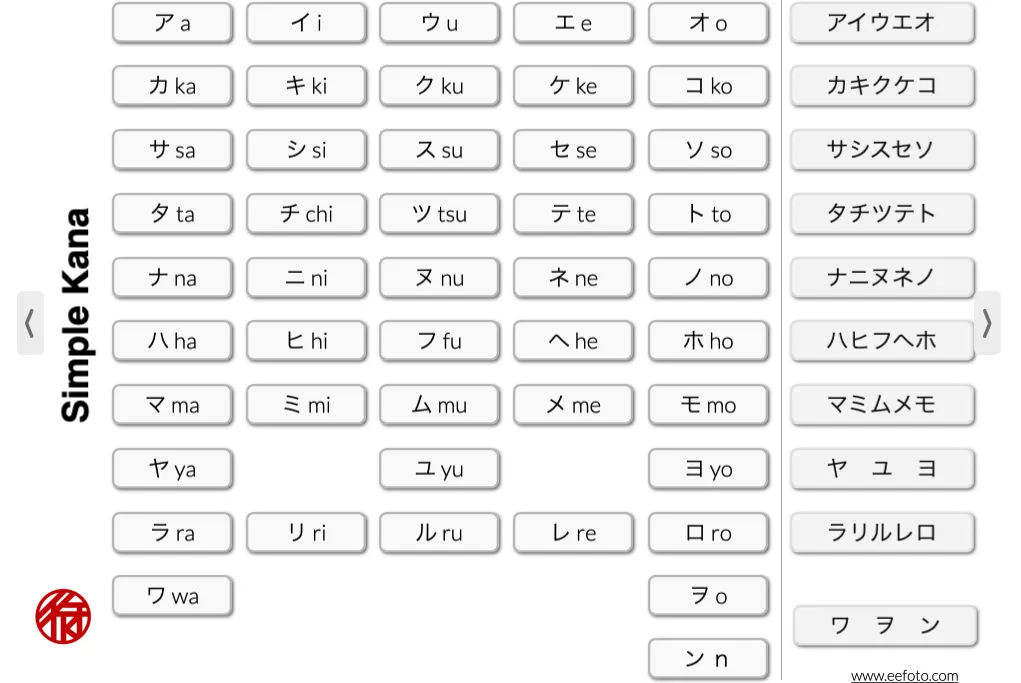
I recorded the basic kana sounds to help you practice Japanese pronunciation. Click the button below each character to hear its sound.
k | s | t | n | h | m | y | r | w | ||
a | ア a | カ ka | サ sa | タ ta | ナ na | ハ ha | マ ma | ヤ ya | ラ ra | ワ wa |
i | イ i | キ ki | シ shi | チ chi | ニ ni | ヒ hi | ミ mi | リ ri | ||
u | ウ u | ク ku | ス su | ツ tsu | ヌ nu | フ fu | ム mu | ユ yu | ル ru | |
e | エ e | ケ ke | セ se | テ te | ネ ne | ヘ he | メ me | レ re | ||
o | オ o | コ ko | ソ so | ト to | ノ no | ホ ho | モ mo | ヨ yo | ロ ro | ヲ (w)o |
ン n |
Notes
シ is romanized as shi.
チ is romanized as chi.
ツ is romanized as tsu.
フ is commonly romanized as fu. Its Japanese pronunciation is not exactly the same as the English sounds “fu” or “hu.”
ヲ is usually pronounced close to o in modern Japanese.
Japanese “r” sounds are different from both English “r” and “l.”
Long Vowels and Small Characters in Japanese Katakana
When writing foreign names and loanwords in Japanese, basic katakana is only the beginning. Japanese also uses long vowels and small characters to represent sounds that do not fit the basic kana chart.
Long vowels
A long vowel is held for approximately twice as long as a short vowel.
In katakana, long vowels are commonly written with the prolonged sound mark:
ー
For example:
ケーキ (kēki) — cake
コーヒー (kōhī) — coffee
スーパー (sūpā) — supermarket
The mark ー is written after the vowel sound that is extended. It is used mainly in katakana words.
Small ャ, ュ, and ョ
Small ャ, ュ, and ョ combine with kana ending in an i sound to create new sounds.
Examples:
キャ (kya)
キュ (kyu)
キョ (kyo)
シュ (shu)
チョ (cho)
ニャ (nya)
Compare:
キ (ki) → キャ (kya)
シ (shi) → シュ (shu)
チ (chi) → チョ (cho)
The small character is important. For example, チヨ represents chiyo, while チョ represents cho.
Small ッ
Small ッ, called sokuon, indicates a short pause before the following consonant. In romanization, it is often shown by doubling the next consonant.
Examples:
ベッド (beddo) — bed
カップ (kappu) — cup
サッカー (sakkā) — soccer
Compare:
サカ (saka)
サッカー (sakkā) — soccer
The small ッ changes the pronunciation, so it should not be confused with the full-size ツ.
Small vowels
Small vowel characters are used to represent sounds from foreign languages that are not part of traditional Japanese pronunciation.
Examples:
ティ (ti)
ディ (di)
ファ (fa)
フィ (fi)
フェ (fe)
フォ (fo)
ウェ (we)
ウォ (wo)
These combinations are especially useful when writing foreign names and words.
Summary
When converting a foreign name into katakana, check whether it includes:
A long vowel: ー
A combined sound: キャ, シュ, or チョ
A short pause: small ッ
A foreign sound: ティ, ファ, or ウェ
Using these characters correctly can make a katakana spelling sound more natural and closer to the original pronunciation.
Free Interactive Kana EPUB
Practice Japanese katakana with this free interactive EPUB.
Want to see your name written in a decorative Japanese style? Explore the EEFOTO name-stamp collection.