How to Write a Foreign Name in Japanese Katakana: A Four-Step Guide
Step 1: Focus on pronunciation, not spelling
Step 2: Find possible katakana spellings
2.2 Look for an established Japanese spelling
2.4 Use a katakana conversion website
Step 3: Listen to the katakana pronunciation
3.1 Imagine hearing your name at a Japanese office
Step 4: Choose the most natural and recognizable form
The name’s language and country
Understand the limits of Japanese pronunciation
Writing a foreign name in Japanese is not a matter of replacing each Latin letter with a Japanese character. Japanese katakana represents, so the most important step is to identify how the name is pronounced.
Because Japanese and other languages use different sound systems, there may not be one perfect katakana spelling for every name. This guide explains how to find a natural starting point, compare possible spellings, and check the pronunciation.
*This guide is for general language and practical reference. If you already have an official katakana spelling on a Japanese document, use that exact spelling consistently.
Step 1: Focus on pronunciation, not spelling
The first question is not:
“How is the name spelled?”
The better question is:
“How is your name pronounced?”
Japanese katakana normally represents the pronunciation of a foreign name rather than its written letters.
Step 2: Find possible katakana spellings
Compare several sources
There may be more than one reasonable katakana spelling for a name. You can compare the possibilities before choosing one.
2.1 Ask a Japanese speaker
A native Japanese speaker can often identify which spelling sounds most natural, especially for:
Unusual names
Names from less familiar languages
Names with difficult consonants
Names with several possible pronunciations
2.2 Look for an established Japanese spelling
Some names already have a commonly used spelling in Japanese.
Established spellings may be used in books, newspapers, maps, Japanese Wikipedia articles, official translations, and everyday conversation.
However, not every foreign name has one universally accepted spelling. Some forms became established many years ago and may not reflect modern pronunciation. Personal preferences, regional conventions, and changes in pronunciation can also lead to different katakana spellings.
2.3 Use an AI tool carefully
An AI tool can suggest possible katakana spellings and explain the sound changes. However, it may misunderstand the pronunciation or assume the wrong language.
When asking for help, provide:
The name
The person’s country or language
A pronunciation guide
An audio recording, if possible
The intended use
Treat the result as a suggestion, not as an official answer.
2.4 Use a katakana conversion website
You can search for:
English name katakana converter
foreign name katakana converter
外国人名 カタカナ 変換
Conversion tools are useful for finding a starting point, but they may not know the person’s preferred pronunciation. If a tool offers several choices, compare them rather than accepting the first result automatically.
Step 3: Listen to the katakana pronunciation
After selecting one or more possible spellings, copy the katakana into a translation or pronunciation tool.
For example:
Copy the katakana spelling.
Open Google Translate or another Japanese pronunciation tool.
Select Japanese as the language.
Paste the katakana into the text box.
Play the audio.
Compare the sound with the original name.
If you have several possible spellings, listen to each one and compare them.
Listening is useful, but automated pronunciation is not always perfect. When accuracy matters, ask a Japanese speaker to check the result.
3.1 Imagine hearing your name at a Japanese office
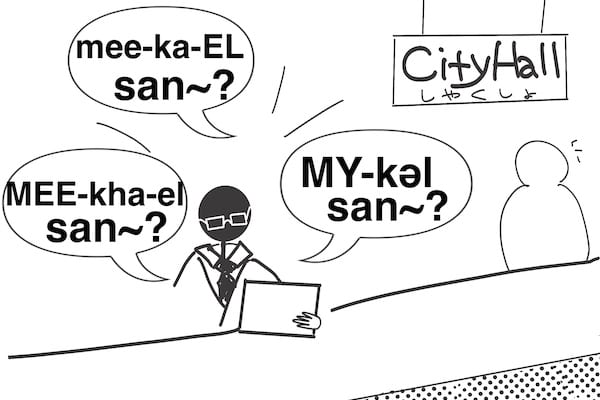
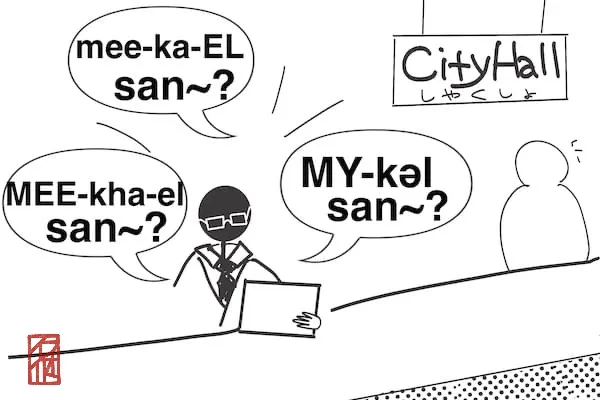
Imagine that you are at a city office, bank, or clinic in Japan. A staff member calls out your name using the katakana spelling you selected.
“□□□さん”
Would you recognize it immediately?
Listening to the katakana pronunciation before choosing it can help you decide whether the name still sounds familiar and recognizable. If it sounds too different from your original name, compare another possible spelling or ask a Japanese speaker for advice.
Step 4: Choose the most natural and recognizable form
The best katakana spelling should balance two goals:
It should sound reasonably close to the original pronunciation.
It should be understandable and natural to Japanese speakers.
Writing a foreign name in Japanese katakana is mainly a process of matching pronunciation to Japanese sounds. Since Japanese cannot reproduce every foreign sound exactly, the result is often an approximation. The goal is to choose a form that is close to the original pronunciation, natural for Japanese readers, and consistent in use.
Important considerations
The name’s language and country
The same written name can have different katakana spellings depending on the language or country of origin.
For example, may be pronounced differently in English, French, Spanish, or German. A name such as can also have different pronunciations depending on the speaker.
For example, Michael may be written differently according to pronunciation:
English Michael : MY-kəl→ マイケル
German Michael: MEE-kha-el→ ミヒャエル
French Michael: mee-ka-EL→ ミカエル
Similarly, Stephan may be:
Pronounced “Stef-an” → ステファン
Pronounced like “Steven” → スティーブン
German Stefan → シュテファン
When checking a name, consider:
Your preferred pronunciation
Understand the limits of Japanese pronunciation
Japanese has a more limited sound system than many other languages. It does not contain an exact equivalent for every foreign sound.
Many Japanese sounds include a vowel. As a result, foreign consonants and consonant clusters may need to be adapted.
For example:
English Smith may become スミス
English Mark may become マーク
These forms are not exact copies of the original sounds. They are Japanese approximations that remain recognizable.
Difficult consonants
Some foreign sounds do not have an exact Japanese equivalent.
The English “r” and “l”
Japanese does not distinguish English and in the same way as English.
For example, depending on the name and convention:
Lisa → リサ
Laura → ローラ
Robert → ロバート
The Japanese sound represented by ラ, リ, ル, レ, ロ is not exactly the same as either English “r” or English “l.”
The “th” sound
English has no exact basic Japanese equivalent. It may be approximated using sounds such as:
サ
シ
ザ
ディ
The best choice depends on the specific name and pronunciation.
Final consonants
Japanese words generally do not end with most consonants. The main exception is the sound.
As a result, a final consonant may require an added vowel or another adjustment.
For example:
John → ジョン
James → ジェームズ ends with a soft “z” sound
James → ジェームス ends with a Japanese “su” sound
Smith → スミス
The added vowel helps the name fit Japanese pronunciation patterns.